When screen time gets brought up, it feels like the conversation comes back to one main question: how much is too much? But researchers are increasingly asking a different question, and the answer is reshaping how parents, educators, and pediatricians think about the issue. The question isn't simply how long a child spends on a screen. It's what happens when you interrupt that time and what you replace it with.
What Continuous Scrolling Does To Brains
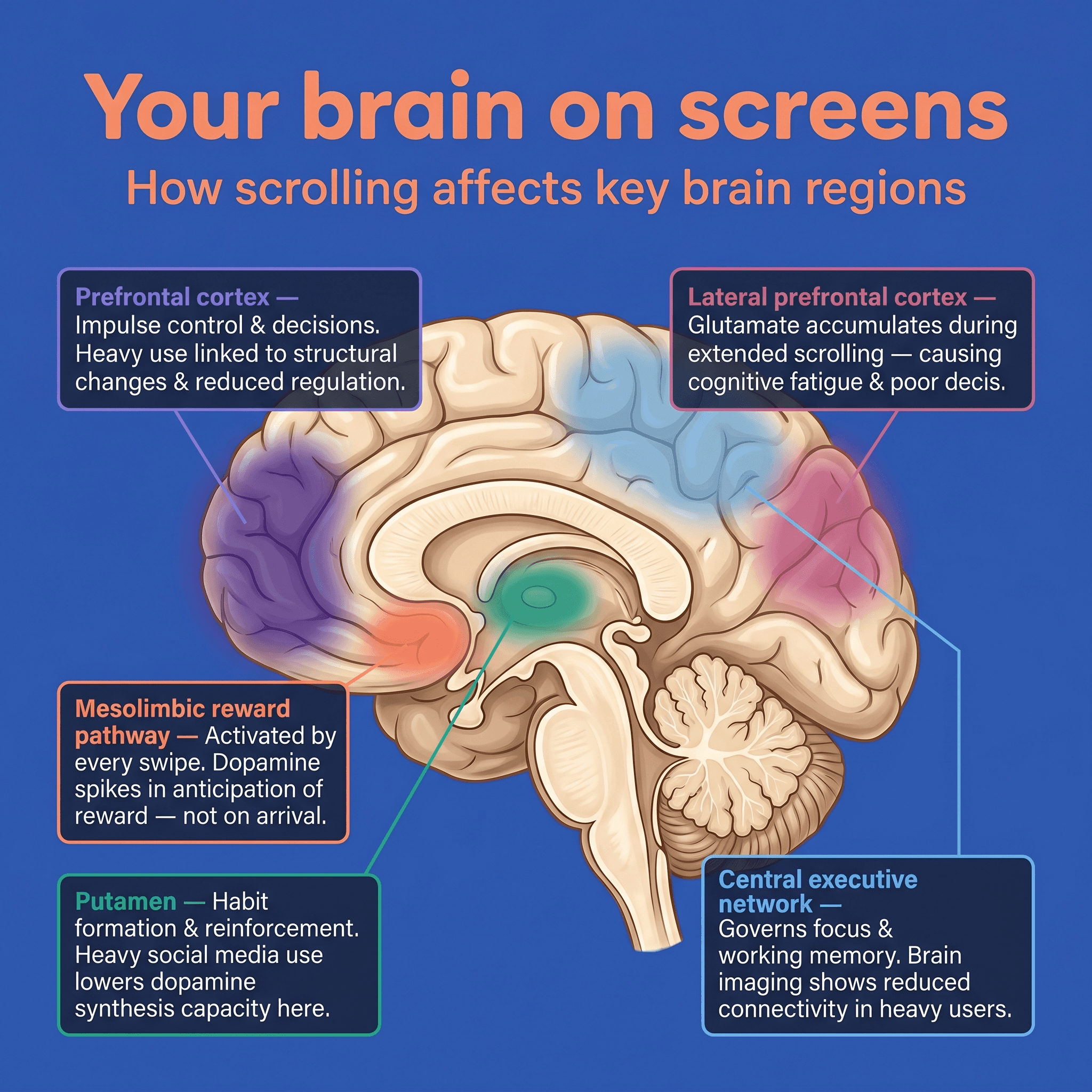
To understand why screen breaks matter, it helps to understand what the brain is actually doing during a scrolling session. Every swipe through a social media feed activates the brain's mesolimbic reward pathway (the same circuitry triggered by food, social approval, and novelty). At the center of this system is dopamine, a neurotransmitter that drives seeking and anticipation behavior. Yes, you read that right: dopamine isn't released when a reward arrives. It spikes in anticipation of one. This is why the next post is always more compelling than the one you just saw. The brain is perpetually chasing a reward that never fully satisfies.
Social platforms are engineered around this mechanism. Infinite scroll removes the natural stopping cue the brain needs to disengage. This is called a variable reward schedule, and it’s the same principle that makes slot machines compelling. When the content substance is unpredictable, the brain generates more dopamine response than consistent content would. Research published in iScience found that individuals who spent more time on social apps showed measurably lower dopamine synthesis capacity in the putamen, a brain region central to habit formation and reinforcement learning. The implication: heavy social media use doesn't just exploit the dopamine system — it begins to alter it.
For adolescents, this is particularly concerning. The prefrontal cortex (responsible for impulse control, decision-making, and emotional regulation) doesn't fully mature until the mid-twenties. Johns Hopkins researchers have linked heavy social media use in adolescents to structural and functional changes in exactly these regions, with patterns consistent with reduced capacity for attention regulation and impulse control. Brain imaging studies have also shown reduced connectivity in the central executive network that governs focus, working memory, and the ability to shift attention deliberately.
There is also a neurochemical cost to extended scrolling that accumulates over a session. As the prefrontal cortex sustains cognitive effort, excitatory neurotransmitters including glutamate begin to accumulate in the lateral prefrontal cortex. Research from the Paris Brain Institute found that this buildup is a measurable marker of cognitive fatigue, and that it impairs both decision quality and attention regulation. The brain, in effect, runs a deficit it cannot clear without rest. Meaning, even something as the low-grade effort of processing a constant stream of ever-changing stimuli can have a significant negative impact on a child’s attention.
What the Brain Does with an Interruption
When the mindless scroll is interrupted, the brain undergoes a profound shift in state. Most screen-time tools aim for "cognitive disengagement", basically asking the brain to go idle. However, the latest neuroscientific research suggests that for a developing brain, the most effective way to break a dopamine loop isn't just to stop, but to pivot.
Functional MRI research has shown that even a brief mid-task break measurably restores the brain's network efficiency. In studies using sustained attention tasks, participants who received a break maintained local neural efficiency across the session, while those without a break showed a significant post-task decline. The break, in neurological terms, releases the demands on depleted cognitive resources and allows the brain to reorganize toward a more integrated and efficient state.
Critically, not all breaks are equal. Passive breaks, including scrolling on a different app, do not produce the same restorative effect, because they continue to engage the dopamine-seeking loop and place ongoing demands on attentional systems. The restoration researchers observe comes from genuine cognitive disengagement from passive consumption, ideally paired with a shift to active, structured engagement. This is where the microlearning research becomes relevant.
What Pediatric Doctors Say
In updated guidance, the American Academy of Pediatrics moved away from prescriptive time limits, acknowledging that a blanket hours-per-day framework doesn't reflect how children actually use technology or what the research shows about harm. Their current position: what matters is whether screen time is supporting healthy development — cognitively, socially, and emotionally. The shift is from quantity to quality and context.
This framing aligns directly with what neuroscience and intervention research show. The goal isn't elimination: it's structured interruption. Brief breaks restore the attentional capacity that continuous scrolling depletes. When those breaks include active cognitive engagement rather than further passive consumption, the benefit compounds: the dopamine loop is interrupted, the default mode network has space to activate, and the brain shifts from a depleted seeking state into one better equipped for learning and memory consolidation.
Where Grogo Fits
Grogo was built around healthy screen time for growing minds. We let parents set the interruption intervals, their choice of every 15, 30, or 45 minutes. The app interrupts the child’s scroll with a short set of grade-appropriate questions across subjects including math, science, history, English, financial literacy, and internet literacy. Children answer enough questions to unlock their apps again. The break is brief by design, questions are structured by grade level and adapt in difficulty based on the pattern of the child's responses. Grogo is designed to build confidence and self-esteem by the act of earning their way back to the scrolling.
Each of these design choices reflects the research. The interruption breaks the variable reward loop before tolerance accumulates. The adaptive difficulty ensures the cognitive load stays in the productive zone: challenging enough to drive encoding, not so demanding as to trigger avoidance. And research on autonomy-supportive interventions consistently shows they outperform control-based approaches in children and adolescents, which is why Grogo frames the break as something earned back, not taken away. Our goal is not to punish kids, but to wake them up from mindless scrolling and grow active minds.
Sources
American Academy of Pediatrics. "Screen Time Guidelines." AAP Center of Excellence on Social Media and Youth Mental Health, Q&A Portal Library. AAP, n.d. aap.org
Frontiers in Psychology. "Mixing Subjects and Interleaved Practice in Learning." Frontiers in Psychology, 2025. frontiersin.org
Johns Hopkins Bloomberg School of Public Health. "Social Media and Mental Health in Children and Teens." Hopkins Medicine, Johns Hopkins University. hopkinsmedicine.org and hub.jhu.edu
Monib, A., et al. "Spaced Repetition and Learning Retention: A Systematic Review of 40 Studies." PubMed/NCBI, 2025. pubmed.ncbi.nlm.nih.gov
eLearning Industry. "Microlearning Statistics, Facts, and Trends." eLearning Industry, n.d. elearningindustry.com
Schmidt-Persson, J., et al. "Effect of Reduced Recreational Screen Time on Children's Behavior, Emotional Symptoms, and Peer Relationships: The SCREENS Randomized Clinical Trial." JAMA Network Open 7, no. 7 (2024). jamanetwork.com | Free full text via PMC
Silva, M., et al. "Microlearning in Basic Education: A Systematic Review of 14 K–12 Studies." Education Sciences 15, no. 3 (2025): 302. MDPI. mdpi.com