
Here's a stat worth sitting with: 86% of parents say they have screen time rules in their home, but only 19% say they stick to those rules all the time. Sound familiar? You're not alone, and you're not failing. Managing screen time is genuinely hard, but it can not be ignored.
Why Structure Matters
A 2023 academic review published in Family Perspectives by Angela Webb takes a hard look at what excessive screen time actually does to kids. One of Webb's key observations was the danger of the “digital babysitter”. When a device is consistently used passively, without intention or meaningful interaction, it can chip away at emotional development, cognitive growth, and social skills.
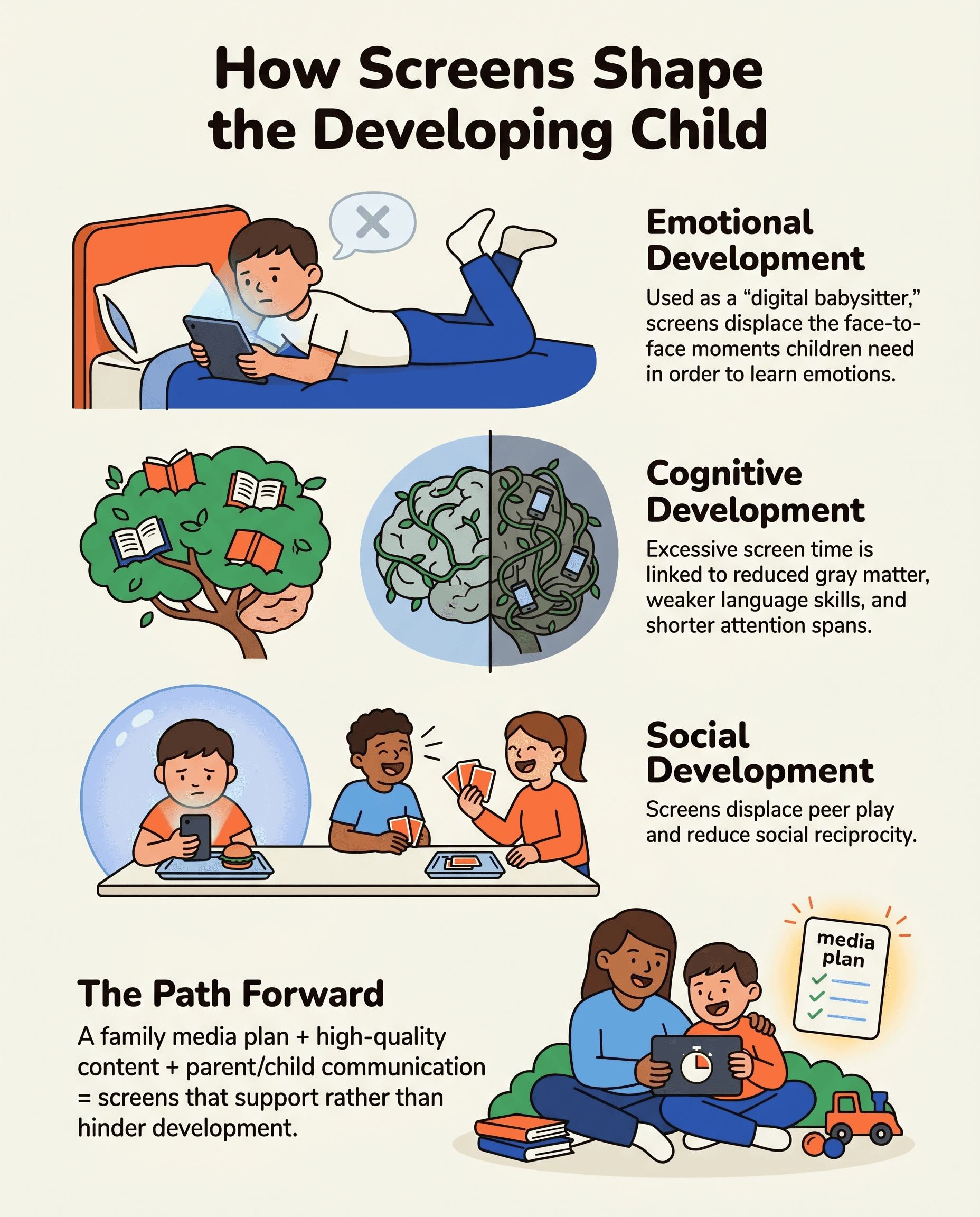
Allowing screen time to continue passively in the home can be quite dangerous for children, and research shows that parents stepping in and adding structure makes all the difference.
The Solution
The American Academy of Pediatrics calls it a Family Media Plan: a shared, intentional set of decisions your household makes together about how, when, and why screens get used. Children's media use has real benefits: opportunities for learning, creative expression, and social connection, alongside real risks. The goal isn't to eliminate screens; it's to make intentional choices about them.
It's never too early to discuss screen media habits and experiences as a family. That conversation doesn't have to be a lecture, and, in fact, research says it shouldn’t be.
A European multi-country study found that an autonomy-supportive style of communicating rules about screen use (rather than a controlling one) was associated with lower overall screen time and less perceived excessive screen use in children. In other words, kids who feel like they have a voice in the rules follow them better than kids who simply had rules imposed on them.
First, try talking to your partner (and doing your own research!) on what you want screen time to look like in your home. Find out what kind of apps exist to help you achieve your goals and consider taking a magnifying glass to all of the ways screens impact each family member’s life. After you establish what you feel is fair, try to find ways to give your child a choice in the official plan.
Grogo gives your family media plan some serious backup. We strive to give kids necessary breaks to make sure that screen time isn’t passive. You (and your child) can choose the apps that get interrupted, the subjects of the questions, and the break intervals. And your parent dashboard gives you an at-a-glance picture of exactly how your child is doing: breaks completed, questions answered, subjects covered.
Everyone stays healthy and accountable with Grogo.
Sources
Chassiakos, Yolanda Linda Reid, Jenny Radesky, Dimitri Christakis, Megan A. Moreno, and Corinn Cross. "Children and Adolescents and Digital Media." Pediatrics 138, no. 5 (2016): e20162593. pmc.ncbi.nlm.nih.gov
Moreno, Megan A., Jenny Radesky, Mary Claire Walsh, and Suzy Tomopoulos. "The Family Media Plan." Pediatrics 154, no. 6 (December 2024): e2024067417. publications.aap.org
Pew Research Center. "How Parents Approach Their Kids' Screen Time." October 8, 2025. pewresearch.org
Webb, A. "Childhood Screen Time and Child Development." Family Perspectives 5, no. 1 (2023): Article 7. scholarsarchive.byu.edu