Ways parents can stay involved in their children’s digital lives while supporting trust, communication, and growing independence.

There's a real tension in modern parenting. Ask "what are you up to?" too many times a day and a kid starts to feel hovered over, tracked, maybe even a little suspicious of their own bedroom door. Ask too little and it can feel like nobody's paying attention at all.
Good news: the research doesn't actually ask parents to interrogate their kids more. Staying loosely aware of what's going on, without turning every screen session into twenty questions, is what actually moves the needle for kids.
Staying Connected Strengthens the Relationship
A 2025 study in Behavioral Sciences looked at a national U.S. sample of families, many of them juggling the packed, unpredictable schedules that come with two working parents, and asked a genuinely useful question: when routines get chaotic and time is tight, what actually protects a kid? The researchers weren't just measuring stress levels. They were testing whether the parent-child relationship explained why some kids held up better than others even when the schedule was a mess. It did. Relationship quality fully explained the connection between household stress and kids' mental health, and it explained a good chunk of the connection to their physical health too. In other words, a packed calendar doesn't have to be the deciding factor. The strength of the relationship is.
Having this relationship does not require a perfectly Pinterest-worthy parenting style, and it definitely doesn't require a nightly debrief. It requires being present enough to notice the shape of your kid's world, without needing them to narrate every piece of it.
Staying Aware of Tech Use Specifically Matters Too
Screens are where a lot of modern parent guilt concentrates, so let's call this out right now: the research on tech is just as encouraging for parents who stay loosely aware, no interrogation required.
A 2025 study in Frontiers in Psychology followed preschoolers and found that when parents stayed actively involved in what their kids were watching and playing, rather than just handing over a device, entertainment screen time stopped being a drag on early literacy skills. The involvement was the variable that mattered.
A 2024 study on Chinese families ages 6 to 17 found that kids whose parents stayed actively engaged with their internet use, aware of what they were doing and open to talking about it when it came up, showed a meaningfully lower risk of problematic internet use than kids whose parents took a hands-off approach.
A 2025 meta-analysis in Journal of Medical Internet Research (JMIR) Pediatrics and Parenting also reviewed digital safety programs across multiple studies and found that when parents built up their own knowledge and skills around their kids' digital habits, actual screen time dropped for both parents and kids. Awareness changed behavior, without a single rule being handed down.
The Helicopter Problem
Put all of this together and a pattern shows up: kids do better with tech (and with their parents) when a parent stays aware rather than checked out, and when that awareness doesn't come from constant questioning. Here's the catch, though. Kids can feel the difference between a parent who's aware and a parent who's hovering, and they don't love the second one. Constantly asking "what are you playing," "who are you talking to," "are you supposed to be on that" can start to feel less like interest and more like surveillance, even when the intent behind it is completely loving.
A 2026 analysis in Current Psychology dug into this using a method called latent family profile analysis. It sorts parents into natural clusters based on which mediation strategies they actually use (rather than assuming everyone falls into one neat category). Purely restrictive parents, the ones who mostly limit time and lock down apps, saw lower numbers on things like total screen time and use of specific apps. But the profiles that also offered opportunities for open, calm communication and discussion, building a kid's own judgment along the way, saw better outcomes on the harder problems, like cyberbullying. A locked-down app can't do the work of a kid who actually knows what to do when something feels wrong. The strongest profile combined both: some structure, plus room for the kid to grow into handling things themselves.
A Built-In Way to Stay in the Loop
So the goal isn't more interrogations. What parents need is somewhere in between: close enough to know what's going on, relaxed enough that it doesn't feel like tracking.
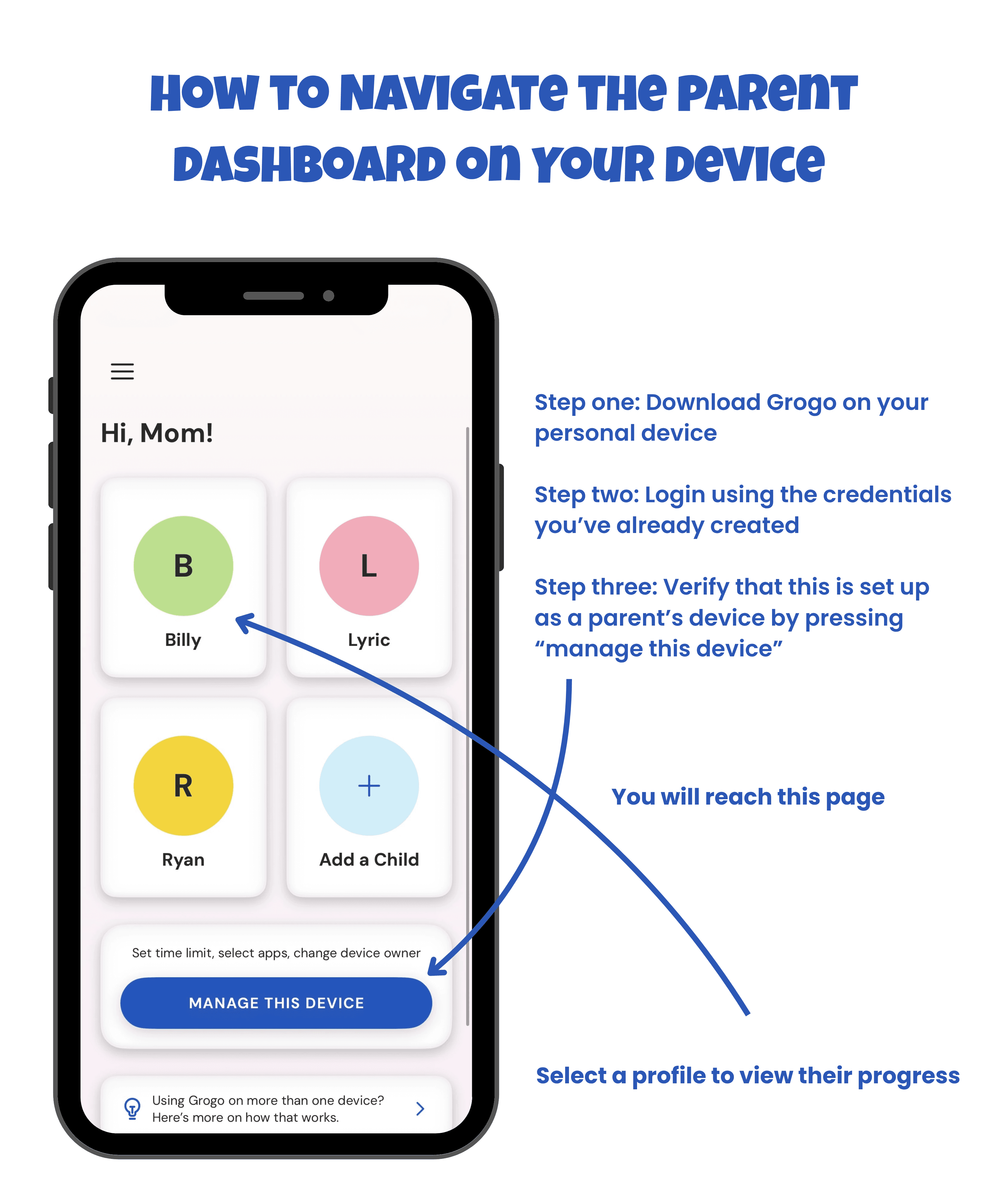
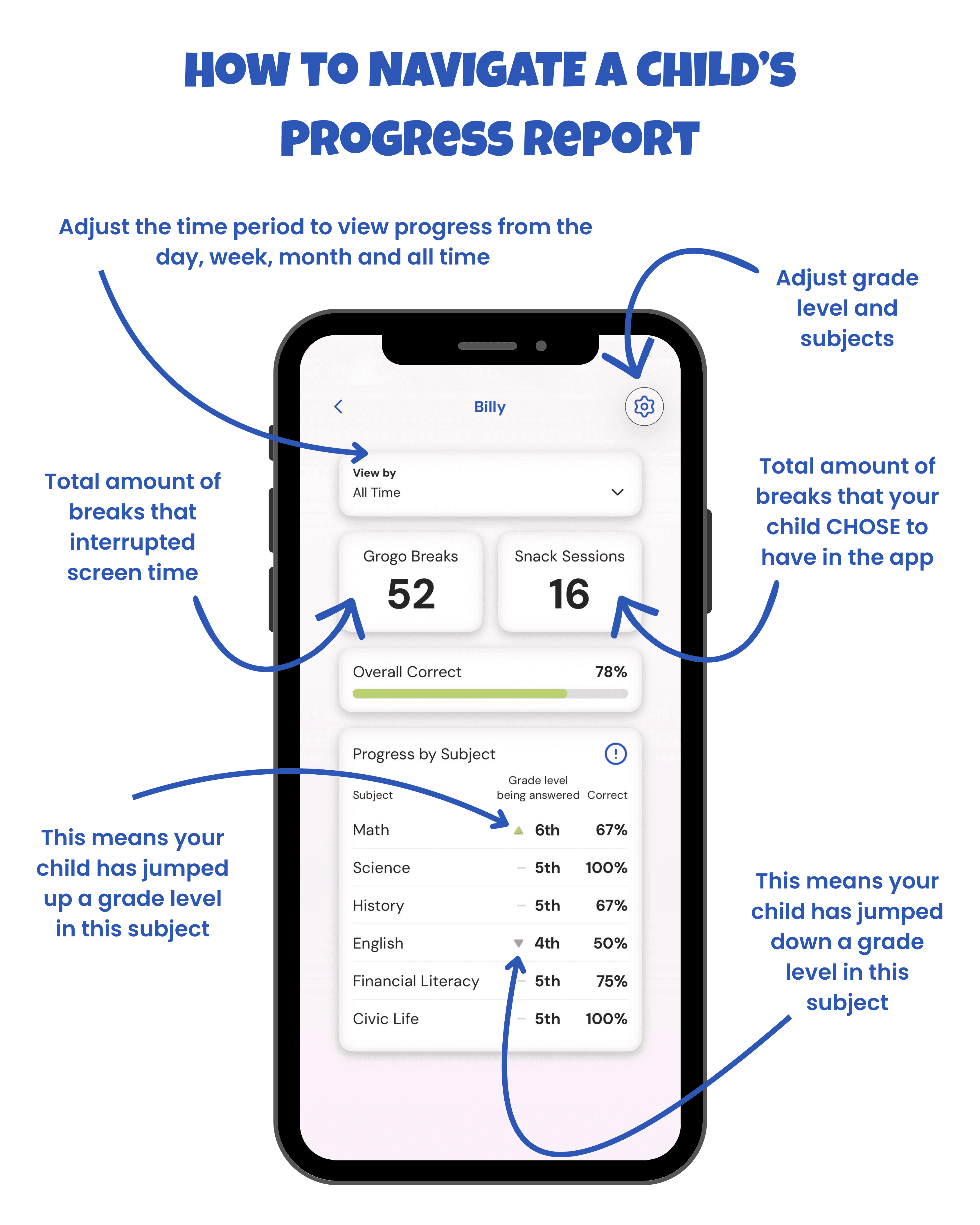
That's the gap Grogo was built to close. Every time a kid earns their way back into their game or show by answering a few grade-level questions, that activity shows up on a simple parent dashboard automatically. Without taking their child's device, parents get a clear picture of what subjects they're strong in, where they're stumbling, how often their brain breaks are happening, and how each one is going, so a parent already knows before the question is even asked.
It also gives a parent something better to talk about than "what were you doing on your phone." A kid who just crushed a run of financial literacy questions is a lot more likely to light up hearing "hey, I saw your grade level just went up in financial literacy, tell me something you've learned" than hearing any version of "so, did you just play those games all day?"
Staying in the loop doesn't have to mean asking more. Sometimes it just means having a better way to already know.
Sources
Rodriguez, V., Cottrell, J., & Jia, F. (2025). "Parental Stress, Parent-Child Relationship, and Child Wellbeing: A National Study of Family Life After COVID-19 Pandemic." Behavioral Sciences.
https://www.ncbi.nlm.nih.gov/pmc/articles/PMC12561007/
Frontiers in Psychology (2025). "The impact of screen exposure on early literacy skills of preschool children: the mediation of parental media intervention."
https://www.frontiersin.org/journals/psychology/articles/10.3389/fpsyg.2025.1745413/full
Parenting Style and Child Internet Addiction in China: Mediation Effect of Parental Active Mediation (2024).
https://www.ncbi.nlm.nih.gov/pmc/articles/PMC12026999/
JMIR Pediatrics and Parenting (2025). "Effect of Digital Safety Interventions on Parental Practices in Safeguarding Children's Digital Activities: Systematic Review and Meta-Analysis."
https://pediatrics.jmir.org/2025/1/e70745
Current Psychology (2026). "Perceptions of online parental mediation, screen time and social networks in minors: a latent profile analysis."
https://link.springer.com/article/10.1007/s12144-026-09047-z