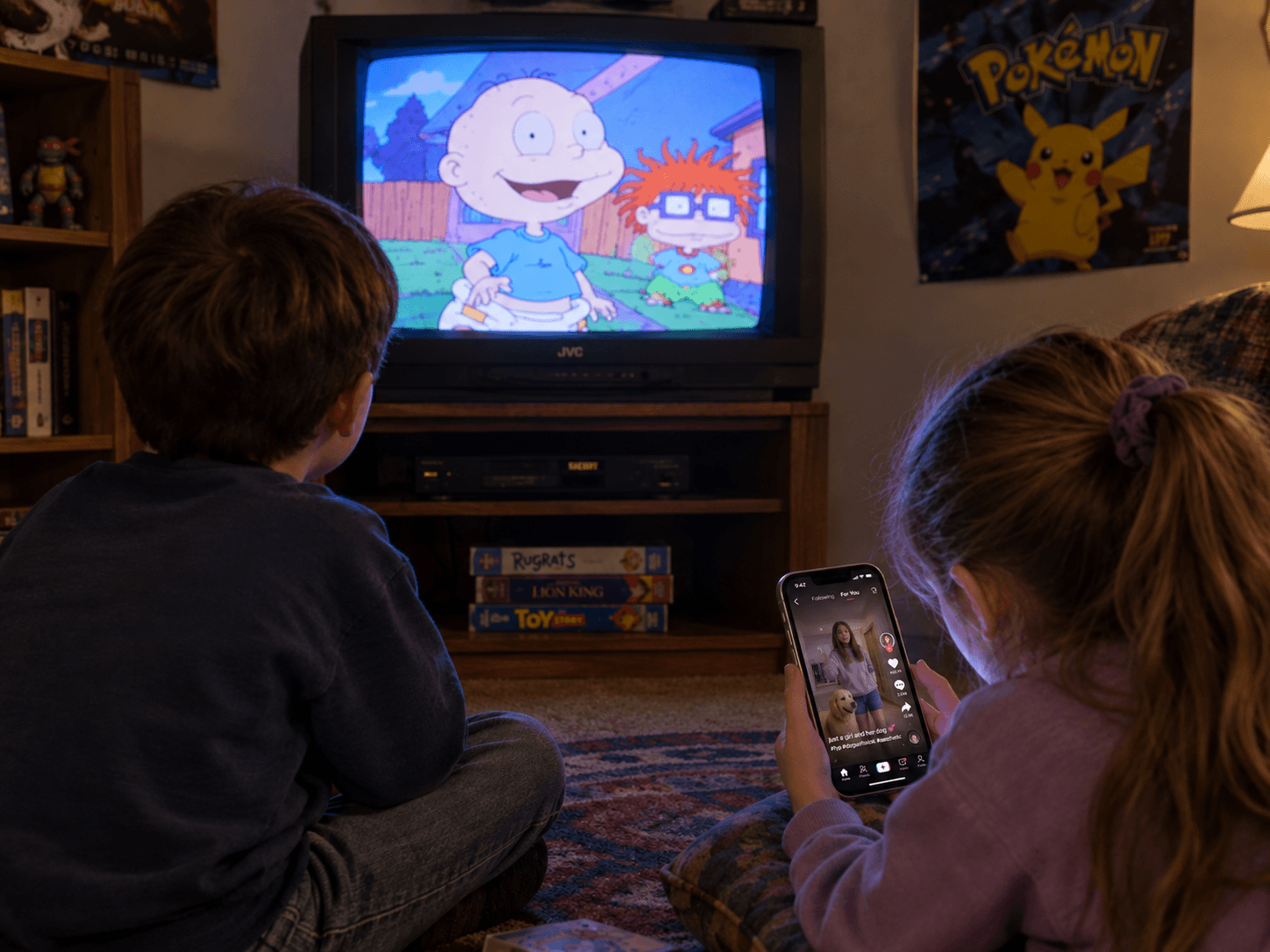
For most of TV history, kids’ shows came with built-in pauses. Every few minutes the cartoon stopped and someone tried to sell them a sugary cereal or the newest toy. Nobody thought much about it. That was just how screens worked.
Today’s apps took the breaks out. Autoplay rolls straight into the next video. The feed never ends. There’s no natural moment to look up, and that’s by design.
We think the break deserves a comeback. Just a much better one.
Pediatricians Changed the Question
In January 2026, the American Academy of Pediatrics published a new policy statement, Digital Ecosystems, Children, and Adolescents, that moves past counting hours. The AAP now asks families to look beyond simple time limits and focus on quality, context and conversation.
Two parts of that guidance stood out to us. First, the AAP names the problem plainly: engagement-based design. Autoplay, endless scroll and similar features are built to hold attention, and they crowd out sleep, play and family time. Second, it calls on the people who build apps to practice child-centered design, making products that work for kids’ well-being instead of against it.
That’s a design problem. And design problems have design solutions.
Put the Pause Back, and Fill It with Something Good
Grogo is our answer. At intervals parents choose (every 15, 30 or 45 minutes), Grogo pauses the entertainment apps parents select and serves up a short set of grade-level questions in math, science, English, history, financial literacy, civic life and pop culture. Answer correctly and the apps come right back. A five-minute heads-up means the pause is never a surprise.
Questions adapt as kids improve, so each break feels like a challenge they can win, not a wall they hit. One of five animated characters delivers the questions and cheers them on. Each break ends with a quick “Did You Know?” about staying safe online.
What Grogo doesn’t do matters just as much. It doesn’t lock kids out, read their messages or turn parents into the screen-time police. The AAP’s advice to parents includes using parental controls and seeking out content that helps with subjects like reading and math. Grogo does both at once, without the standoff.
Why Short Breaks Do Real Work
The science of how kids remember is some of the most solid in education, and it points in one direction:
Retrieval practice. Roediger and Butler (2011, Trends in Cognitive Sciences) reviewed evidence that pulling an answer from memory builds much stronger long-term retention than restudying it, and that feedback makes the effect stronger still. Every Grogo question is a retrieval, with instant feedback.
Spacing. Cepeda and colleagues (2008, Psychological Science) showed that reviewing material after a gap, instead of all at once, significantly improves how long it lasts. Grogo breaks happen several times a day, every day, so learning is spread out rather than crammed.
Interleaving. Rohrer and Taylor (2007, Instructional Science) found that mixing different kinds of math problems, rather than practicing one kind in a block, improved later test scores. Grogo mixes the subjects parents choose.
Microlearning. A 2025 systematic review by Silva and colleagues (Education Sciences) looked at microlearning in primary and secondary education and found that short lessons delivered through digital tools supported motivation, engagement and performance.
Kids Who Can See Themselves Winning
Parents get a dashboard showing breaks completed, questions answered and where their child is strongest. Kids get their own, so the progress belongs to them. A kid watching their own math results climb isn’t being managed. They’re building something, and they know it.
A Better Kind of Break
The old commercial break taught a generation to want things. A Grogo break teaches kids that they know things.
Same screen. Same apps. A better pause.
Grogo is available on iOS and Android, with a 7-day free trial.
Sources
American Academy of Pediatrics, Council on Communications and Media. (2026). Digital ecosystems, children, and adolescents: Policy statement. Pediatrics. doi.org/10.1542/peds.2025-075320
Munzer, T. (2026). Helping kids thrive in a digital world: AAP policy explained. HealthyChildren.org. healthychildren.org
Cepeda, N. J., Vul, E., Rohrer, D., Wixted, J. T., & Pashler, H. (2008). Spacing effects in learning: A temporal ridgeline of optimal retention. Psychological Science, 19(11), 1095–1102. doi.org/10.1111/j.1467-9280.2008.02209.x
Roediger, H. L., & Butler, A. C. (2011). The critical role of retrieval practice in long-term retention. Trends in Cognitive Sciences, 15(1), 20–27. doi.org/10.1016/j.tics.2010.09.003
Rohrer, D., & Taylor, K. (2007). The shuffling of mathematics problems improves learning. Instructional Science, 35(6), 481–498. doi.org/10.1007/s11251-007-9015-8
Silva, E. S., Costa, W. P. da, Lima, J. C. de, & Ferreira, J. C. (2025). Contribution of microlearning in basic education: A systematic review. Education Sciences, 15(3), 302. doi.org/10.3390/educsci15030302